Why Rickshaws Deserve Policy Recognition in the Transportation Landscape of Bangladesh
By Subah Tarannum
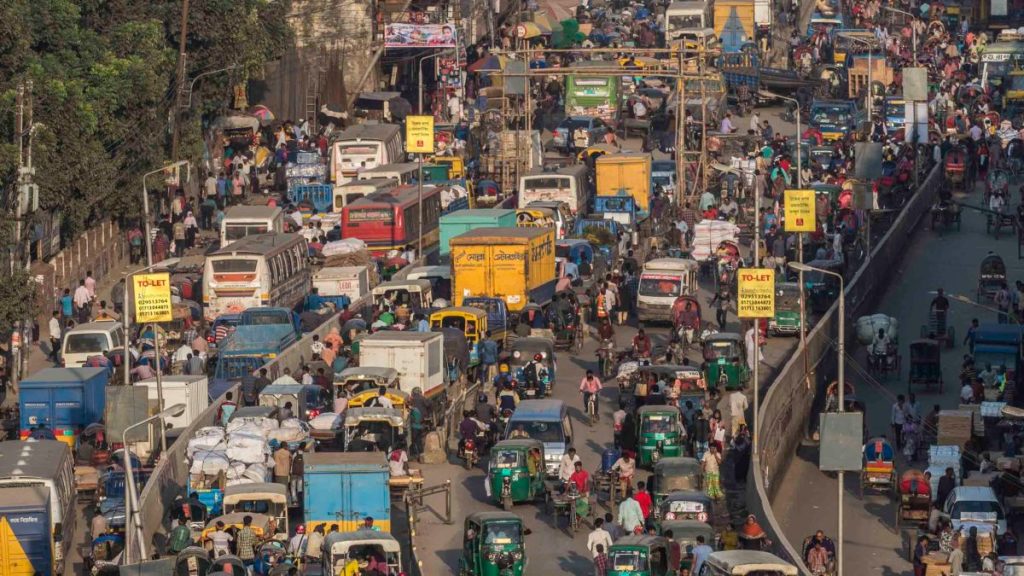
For decades, policymakers and planners have tried to solve Dhaka’s congestion crisis by villainizing rickshaws, building more highways and flyovers, clinging to the hope that wider roads and banning rickshaws from streets would mean faster traffic. But the truth is counterintuitive: the more roads we build, the worse the traffic becomes.
This phenomenon, as explained by the Induced Travel Demand theory, shows that expanding road capacity simply encourages more car use, leading to even heavier congestion, rising emissions, and deteriorating air quality, exactly as seen in the case of Dhaka. Rather than offering a real solution, our obsession with motorized infrastructure traps us in a vicious cycle of congestion and pollution. Such an approach risks sidelining the ubiquitous, low-carbon, and highly viable mode of transportation — Rickshaws — that could, in fact, help ease the gridlock.

Figure: Induced Travel Demand (Source: T4America)
Historically, rickshaws have been part of Bangladesh’s transport fabric for around a century. Beyond mobility, rickshaws in Bangladesh are moving canvases and are an integral part of Bangladesh’s cultural identity due to the famous rickshaw art all over rickshaws – depicting the city’s history, folklore, and contemporary life. And in recent years, rickshaw art has surged in popularity across Bangladesh. You’ll find it prominently printed on t-shirts, decorating cafes/ restaurants, home decor, or featured in glossy exhibitions. Fashion brands and creative collectives celebrate their vibrant colors, folkloric themes, and nostalgic appeal. UNESCO even recognized rickshaw art and craftsmanship in Dhaka as an Intangible Cultural Heritage of Humanity in 2023. Even in the cities of the USA, multiple companies e.g., Manhattan Rickshaws, Central Park Rickshaw Tours have started offering rickshaw tours, charging around $7–$10 per hour; equivalent to 1,000–1,500 Bangladeshi Taka. And yet, while the painted backboards of rickshaws are glorified everywhere, the rickshaw itself – and the pullers who power them, the artists who design them – remain excluded, vilified, and precariously positioned within our cities in Bangladesh.
Behind all these bright visuals that enliven our city of Dhaka, the rickshaw, one of the few zero-emission, human-powered vehicles that has long served millions in Bangladesh, is subject to relentless bans, poorly enforced registration systems, and exclusionary urban and transportation policies. Pedal rickshaws are often viewed as a nuisance and a cause of congestion in Dhaka, but this perspective fails to consider the many environmental benefits, cultural attachments, heritage and mobility justice aspects of the vehicle. Despite failing to achieve the desired effect, the government has attempted multiple times to ban and impose restrictions on rickshaws to reduce traffic congestion, in 2014, 2021, and 2024, resulting in inconsistent policies that oscillate between banning rickshaws and implementing local licensing systems.
But this pattern of exclusion is not just a policy failure; rather, it reflects deeper structural inequalities. The sidelining of rickshaws signals a preference for capital-intensive projects and private vehicles, at the expense of labor-intensive, socially inclusive transport systems like the rickshaw economy. Zahid Hasan Prince, Assistant Professor in the Department of Civil Engineering at BUET, offered a contrasting view: “Pulling a rickshaw is an extremely strenuous and often inhumane occupation. Moreover, Dhaka’s limited road space, which accounts for only 7% compared to the recommended 25%, makes it impractical to accommodate slow-moving rickshaws on arterial roads, where they exacerbate congestion and reduce traffic efficiency. Their operation should be confined to secondary and tertiary roads, integrated under a regulated framework. Though some may argue for preserving them as heritage, we must critically assess whether maintaining such practices aligns with the values of a modern and humane city.”
While I understand and respect Zahid Hasan’s concerns, my point is precisely that: rickshaws remain excluded from all formal transportation planning, leaving no institutional pathway to improve their design, working conditions, or operational efficiency. If we continue treating them as obsolete or incompatible with the vision of a “modern” city, who will invest in making them more humane, safer, or efficient? Who will design better rickshaws? Who will support the livelihoods of those dependent on the rickshaw economy? Restricting rickshaws to certain roads without any formal support structure has repeatedly failed. We’ve seen how banning them from major roads hasn’t meaningfully reduced congestion – it simply pushes the problem elsewhere/ shifts the burden and further marginalizes “transit-captive” populations who have no other affordable or accessible option.
More broadly, I find it troubling how often Global South cities pursue a vision of ‘modernity’ modeled on Global North ideals of motorization— even as Western mobility justice scholars themselves are pushing back against car-dominated systems in favor of low-carbon, people-centered transport and epistemic justice. To add to that, there’s a clear contradiction in chanting “sustainability” while excluding one of the most sustainable modes of transport we already have. To be clear, I am not suggesting rickshaws must dominate all roads, but I am calling for a formal, thoughtful integration of rickshaws into our urban transport plans. Even if limited to secondary or tertiary roads, they deserve infrastructure, policy support, and innovation to thrive as part of an inclusive, humane, and sustainable mobility future. Because the rickshaw industry in Bangladesh is significant, not only for its economic impact but also for the vast number of people it employs, from builders and artists to pullers and commuters. These individuals, who comprise a large and vulnerable segment of the urban workforce, are often entangled in complex and opaque registration processes, experiencing meager incomes and limited bargaining power. Rickshaws are also the primary mode of transport for “transit captive” populations – women, children, the elderly, and low-income communities who lack viable alternatives. In other words, the very people and systems that birthed rickshaw art remain structurally marginalized. This systemic marginalization is compounded by a cultural narrative that valorizes modern forms of transportation while dismissing the socio-cultural and economic contributions of rickshaws.

Not to mention, the process of registration and licensing of the rickshaws is also very complicated or uncertain due to the ever-changing policies and political climate of the country. And while Dhaka has a licensing system for rickshaws, it’s a system that hasn’t been effectively updated since the 1980s, leading to an overwhelming number of rickshaws operating without official licenses. According to the Bangladesh Institute of Labour Studies (BILS), Dhaka has over 1.5 million pedal rickshaws, yet only 3–4% are registered.
Current transportation planning in Dhaka, inspired more by car-centric Western models than local realities, has done little to change this narrative. National policies like the Revised Strategic Transport Plan (RSTP) 2016-2035, Integrated Multi-Modal Transport Policy, and the Bangladesh Climate Change Strategy and Action Plan (BCCSAP) mention “green” mobility and equity in vague terms – but seldom include rickshaws – arguably the greenest transportation mode in Bangladesh – as part of that vision. The Road Master Plan (2009) and BCCSAP discuss the importance of pedestrian-friendly infrastructure, yet rickshaws are not included as part of their non-motorized transportation ecosystem. The country’s NDC Sectoral Action Plan for Transport. 2021 (a living document to assert countries’ commitment to reduce GHG emission and shift towards low-carbon transits) sets ambitious CO₂ emission reduction targets through two key targets: an unconditional reduction of 9% below business-as-usual (BAU) levels by 2030 and a conditional reduction of 24% by 2030, contingent on international support. But, rickshaws are only mentioned twice in the NDC Sectoral Action Plan for Transport, and that too calling for a 50% reduction in rickshaw trips over ten years, despite rickshaws being fuel-free, affordable, and locally embedded.
Musharrat Jahan, currently working as a Transportation Planner at the California Department of Transportation, echoed similar concerns about the uncritical push for Western-style infrastructure in Bangladesh. In her words: “Rickshaws should undoubtedly be an integral part of our transportation policy in Bangladesh. However, instead, we continue to imitate US and other Western models—such as highways and sprawling cities—without stopping to analyze whether they are suitable or transferable to our context. We don’t ask who can afford cars or what kind of travel patterns families really have. The majority of our population cannot afford private cars, and car-centric development leaves them behind.” Reflecting further on the shortcomings of existing alternatives, she added: “Our bus system is outdated and unsafe. CNG auto-rickshaws often feel claustrophobic and are not affordable or accessible for most people. In contrast, rickshaws are affordable, accessible, and safer, especially for women and low-income families. As someone who has lived in Dhaka and from a user’s perspective, I prefer rickshaws because they are moderately affordable, allow for trips of any distance, and provide high accessibility across Bangladesh’s roads, reaching virtually every location. The accessibility of rickshaws is significantly higher than that of cars.”
Currently living in Davis, California – a city that reimagined itself around bicycles, I see how bicycles here aren’t seen as backward or inefficient, rather they are promoted and celebrated as practical, sustainable, and solutionary. What made the difference wasn’t just urban design – it was political will, public advocacy, and a collective vision. In the 1960s, it was ordinary citizens, like Frank and Eve Child, who demanded change and successfully pushed for dedicated bike lanes, bike-only traffic signals, and policies that prioritized cyclists over cars. Today, Davis is hailed as the biking capital of the U.S., with over 100 miles of bike lanes and infrastructure that supports a healthier, cleaner, and more equitable form of urban life.
But Davis isn’t alone in reimagining what our streets can look like. In Copenhagen, Denmark, more than half the population commutes by bike. In Groningen, Netherlands, bikes make up over 60% of all trips: cycling is simply how people get around. Around the world, many cities (e.g., Rotterdam, Utrecht, Berlin, Antwerp, Amsterdam, Malmö, etc.) are showing that biking isn’t just a niche activity, but a real, everyday solution to traffic, pollution, and disconnected urban life. It reminds us that, when cities invest in active transportation (e.g.,human-powered mobility), they’re investing in healthier communities, cleaner air, and streets that feel more human.


In a conversation with Mustafa Fardin, a PhD student in Transportation Engineering at The Pennsylvania State University (Penn State), he offered a powerful reflection on how Bangladesh’s rickshaws are perceived globally, “Although Bangladeshi policymakers tend to say that rickshaws are a unique problem of their own with no “modern” western countries having any use for them at all, it cannot be any further from the truth. The first reverse cultural shock I had was from attending the Transportation Research Board Annual Meeting (TRBAM) in 2024, the largest transportation research conference in the world, where I found that European countries were going all in on electric cargo tricycles, which are a modern and efficient version of rickshaw vans. My conversations with actual city planners from Berlin and Rotterdam had me surprised even further, as they were stating how Bangladeshi rickshaws were their basis for standardized tricycle designs. That has been reflected by the recently passed EN 17860 standard for cargo e-bikes, which also has specifications for tricycles and trailer-based bikes. They were super positive about the prospect of these tricycles in their new cordoning policies for zero emission zones where no internal-combustion engine-based freight vehicles are allowed at any time, and the cargo tricycles solve all the problems at once for them. Therefore, the curse of Bangladesh is actually a blessing for these modern Westernized countries. They are doubling down on their inclusions at specific road types and loading zones like the one set by New York City Department of Transportation.”
And, this makes me think: when Bangladesh already has millions of rickshaws , deeply woven into the economic, cultural, and environmental life of the city, why can’t we design our transport system around them? When rickshaw art is celebrated on textiles, home décor, in exhibitions, and at cultural events, why are the rickshaws themselves – the very canvas that gives rise to this art – left out of formal transportation policy? Why can’t there be a framework or a plan to incorporate them into the formal transportation landscape, especially when so many people (designers, pullers, passengers, etc.) rely on it?
The answer partly lies in flawed assumptions. For too long, our planners have clung to the belief that more roads equal less congestion. But research shows otherwise. The induced demand theory states that building more expressways doesn’t reduce traffic; it increases it. Each new road invites more cars, more emissions, and more congestion. And perhaps the solution lies within us. If Davis could begin designing its cycling infrastructure through citizen advocacy and collective vision, why can’t we do the same? As the saying goes, culture eats policy for breakfast.
Drawing from her experience as both a transportation planner in California and a rickshaw user in Bangladesh, Musharrat Jahan also highlighted the disconnect between policy decisions and the lived realities of the public. She stressed, “We must shift our policy-thinking to a user-centric perspective. Rather than solely focusing on building roads and highways, we should consider how users choose their mode of transportation on these roads and how they can afford it. This involves studying user income and conducting market research to understand public demand. In places like Davis, when there’s a policy change or a new policy being adopted, or if there is any infrastructural shift/development, the authorities hold public meetings where people can share their views and concerns about how the policy might impact them. We should begin to encourage more public participation in policy planning in Bangladesh as well. Rickshaws are deeply connected to the public in terms of emotion, culture, and Bangladesh’s economy. Therefore, we should strive to incorporate people’s views into our planning.”
All that said, it’s no secret that rickshaws are part of all of our lives. We grew up with them. We’ve all had at least some stories or moments in rickshaws that stay with us. Riding with friends on rainy afternoons. Jumping out of a car stuck in traffic to hop onto a rickshaw, just to make it to an exam on time. Having “storm in a cup” conversations with mamas, or being moved by their quiet, powerful life stories. Many of us had our first rides wrapped tightly in a parent’s arms, the city rushing by as we looked out with wide eyes, a gentle breeze brushing through our hair. These are thumbless memories, carried quietly within us. All of us can speak to how much we’ve relied on rickshaws, maybe without even realizing it, and how much we still need them. And that matters. More than anything, we certainly celebrate rickshaw art with pride. So maybe it’s time we channel that love and cultural connection into a political and infrastructural shift to push for the formal inclusion of rickshaws in our transport policies and planning systems. This article is a little part of that effort!

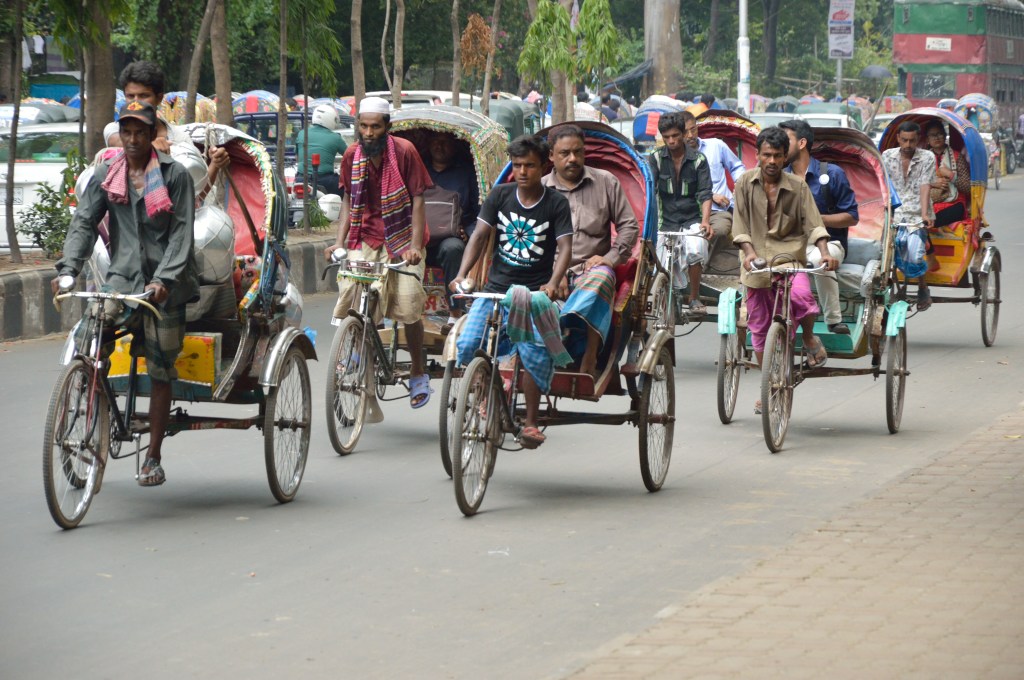

I believe – you can’t pave your way out of a traffic crisis; you can only design your way out. We are caught in a feedback loop that punishes the air we breathe and the communities who rely on non-motorized mobility. And so, we need a new mobility story that centers dignity, sustainability, and access over speed and steel. A just transport system would not just tolerate rickshaws, it would celebrate them and truly support the communities that depend on them. It would provide formal recognition, dedicated lanes, worker protections, and design improvements for accessibility. It would see rickshaws not as relics, but as a roadmap for equitable urban transformation.
If we can frame rickshaws as high art, we can certainly frame them as high policy. It’s time Bangladesh stopped pushing rickshaws to the margins and started placing them at the center of its mobility future. It’s time to make room – on our roads and in our policies – for the rickshaw. Because justice doesn’t ride on silence; it moves with intention.
 The Bengal Gazette