By Joydip Chatterjee
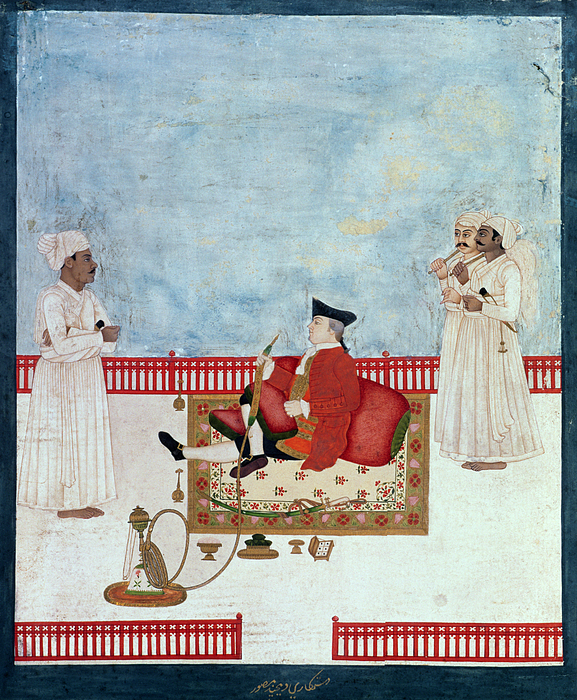
Picture the following. You go to a foreign land, thousands of kilometers away from your home. Even though you do not need to, you go to great lengths to learn the language of the less-privileged locals. You are happy because you believe this ease of communication will allow you to better aid the local population. But as soon as you open your mouth, they ridicule you for the way you speak their language! You talk to some of your friends and they are all facing the same problem. These savage natives have been making fun of the way you speak, disregarding the noble endeavor that drives you. They find it so ridiculous that the tale of your hilarious tongue is passed down through generations, and its depiction in movies and TV shows continues to be a source of amusement for the descendants of those savages almost two centuries down the line. If I were you, I would feel like fabricating a famine to punish this insolent behavior.
The above is exactly the situation faced by the noble Englishman in Colonial Bengal. Period pieces— be it big-budget movies, or the latest ‘life-of-Ramakrishna but this time we focus on a side-character’ adaptation on Television— point towards one inevitable inference: that the English spoke funny Bengali. However, soap operas shouldn’t be taken as a true reflection of society, or else all Indian houses would have grand central staircases. But consider the following poignant note, taken from the preface of one of the earlier Bangla grammar books by Shama Churn Sircar: “The Sahibs, though good Bengalee scholars, are exposed to remarks and even ridicule by speaking the language just as they find it written”. The gravity of the situation is such that Sircar, in the footsteps of legendary fire-hater Rammohan Roy before him, sets out to right the wrong by dedicating the entire second part of the book to explaining the colloquial phraseology of Bangla. Other grammarians follow his example throughout the nineteenth century. Unfortunately, Sircar’s work— like a trick out of legendary train-hater P.C. Sorcar Jr.’s show— has completely vanished from the public eye. The Bengali of the English continues to tickle our funnybones.
But why? Was it their accent, as evident in the famous line “teen goona lakaan?” To some extent, that was certainly the case. But there was also something else at play, and Sircar’s preface itself provides a clue. These harbingers of civilization spoke Bangla “just as they find it written.” Therein lies the issue; for Bangla, like many other languages of the Indian subcontinent, exhibits diglossia. This is a phenomenon where a language has two forms– the High and Low varieties– which are functionally in complementary distribution. In other words, this means that you would not write Bangla just as you speak it every day, and neither would you speak the Bangla that is written in books (with the exception of some specific formal settings, like a courtroom). The sentence “পুষ্প বৃক্ষ-টি মৃত হয়েছে” (IPA: [puʃpo brikkʰo-ti mrit̪o hoet͜ʃʰe]) is perfectly acceptable in a book on Gardening 101, but if you regularly use such tatsam words (directly borrowed from Sanskrit) when talking to friends, you risk being labeled an আঁতেল ([ãt̪el]).
In 19th-century Bengal, the high variety was Sadhu Bhasha (SB), while the low variety was Cholito Bhasha (CB). Today, CB has replaced SB in almost all domains of language use, with the diglossia instead being between High and Low CB (the sentence in the previous paragraph would be an example of High CB). An interesting feature of a diglossic society is that since the low variety is used in everyday speech, it is automatically acquired by children in that speech community. However, learning the high variety does require explicit formal education. Cutting back to the old days, SB was the high variety that needed to be learned by Bengali students, so all grammar books taught it. Since native Bengalis invariably knew CB, there were no resources to learn it. As a result of learning Bangla from books, it was SB that the Englishman had picked up, and used in both written and spoken mediums. Too preoccupied with the goodwill of the natives, he did not notice that the Bangla he was speaking did not sound at all like the Bangla that the Bengalis were speaking.
Yet even this by itself would not be enough, for Sadhu Bhasha was the lovechild of Sanskrit and Bangla; with the former being the torchbearer of all that is considered pure and mighty in the ancient Indian civilization. By comparison, Cholito Bhasha was the lowly language of the uneducated. So how could something as sophisticated as SB be the subject of so much ridicule? The answer lies in the term “savage”. Annoyed at being called savages, the Bengalis decided to own the term and started brutally mocking the speech pattern of the Englishman. The technical term used by scholars to describe this phenomenon is Otherization. This refers to the construction of one or many dominated out-groups by the dominant social group, using perceived differences among them. The differences may be real or imagined, as Otherization belongs to the realm of discourse. The dominated group—the Other— only exists in relation to the Self, and as such highlighting and stigmatizing the differences between them is necessary. While the discriminated Englishman in Colonial Bengal was certainly the dominant force in society in general, in the realm of language he was still a minority (no one apart from him was using SB in their everyday conversations, but then again no one apart from him was complaining about jalapenos being spicy either). Along with his peculiar phonology, the incongruity in the form of his spoken Bengali thus became the subject of colonial-era memes; i.e. he was made fun of. The same SB that was considered pure otherwise, and was even used as a weird flex by Brahmins till just a century ago, became subject to ridicule when spoken by the Englishman. In other words, it was not the language (form/variety/dialect) that was being spoken, but rather who was speaking it (the Other, in this case), that determined how it would be perceived by the native speaker. Not being content with this, the Enlightened Coloniser, in a strangely masochistic move, divided Bengal into two in 1905— all so he could be mocked in two regions for speaking two different standard dialects of Bangla incorrectly.
And so it came to pass that the same natives who had failed to put up a united front during 1857, launched a coordinated xenophobic attack on the benevolent servant of the Empire. Efforts were made to remedy this gross injustice, but Bengalis today continue to take the mick out of the colonial-era Englishman speaking technically correct Bangla— as is evident from this present piece.
The more things change, the more they stay the same. The English have long since departed the scene, but English has not. Not getting the same satisfaction in mocking the Bengali of the English anymore, but addicted to making fun of the way others speak, Bengalis now turn inward.
If you are in Kolkata today, you have two major schools of thought to choose from. You can make fun of the Bengalis who speak incorrect English. It is unfathomable that someone should mess up something as easy as English, with its uniform systems of case and tense, and perfectly predictable phonology. As such, you must make fun of this any chance you get.
You can also go the opposite route, and make fun of people who use English words and structures in their spoken Bengali. Languages are meant to be pure, unevolving monoliths, not reflections of changing social settings and cultural practices. A language as great and storied as Bangla certainly should not be corrupted with inferior influences like English and Hindi (or god forbid, Persian). It is your duty to protect the sanctity of your mother tongue, and you must mock anyone who presents a threat to your cause.Above all, you must remember that the only correct and pure way to speak a language is how you speak it. You are in a free country, and everything else is a free game to be made fun of. In the end, what unites us as Bengalis is not that we all share a mother tongue, but that we all make fun of each other for speaking our own languages incorrectly.
 The Bengal Gazette