By Shaniyat Chowdhury
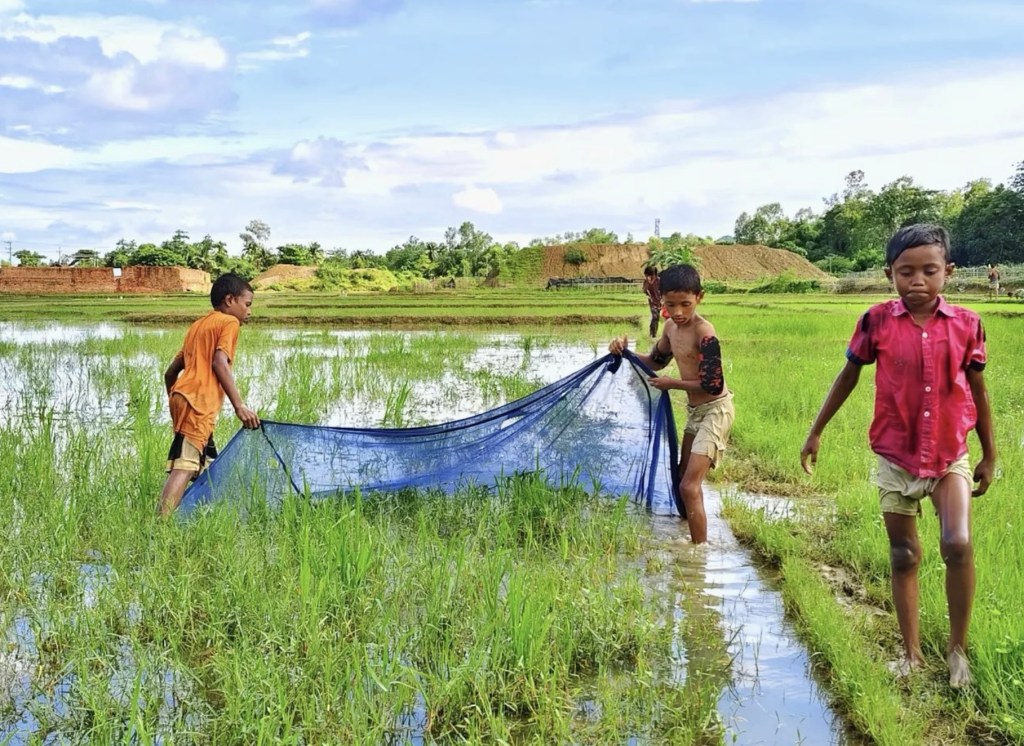
In the sprawling refugee camps of Cox’s Bazar, Chattogram (Chittagong), a heartbreaking tale unfolds as Rohingya children are compelled to abandon their education to work or even take up arms in the armed struggle against the Tatmadaw (Myanmar’s military junta). These children, who should be in classrooms learning and playing, are instead confronted with the harsh realities of ethnic cleansing and mass displacement from a tender age. For many, the decision to drop out of school is not a choice but a necessity — a survival strategy where children support their families given the challenging conditions of life in the camps.
There are nearly one million stateless Rohingya refugees who live in camps in Cox’s Bazar since 2017, when their persecution in western Myanmar turned genocidal, as discussed in depth by Hasan Ahmed for the Bengal Gazette. Insurgent groups such as the Arakan Rohingya Salvation Army (ARSA) have been recruiting youth to their ranks against Myanmar’s junta since at least 2016. Among the children affected by this crisis is 12-year-old Sana, whose dreams of becoming a schoolteacher were shattered when her family fled their homeland in Myanmar to seek refuge across the border in Bangladesh.
With limited resources and her father unable to find work, Sana was forced to drop out of school and take up work in a nearby market to help provide for her family. “I miss my friends and learning new things,” Sana says wistfully. “But my family needs me, so I have to work to help them.” Sana is one of countless children who are being robbed of their rights, as per the 1989 Convention on the Rights of the Child. What goes on in nearby Rakhine, formerly Arakan, should not lead to the disenfranchisement of the rights of children.
The situation is dire, with over 60,000 Rohingya children out of school in the camps, according to recent reports. Many are engaged in hazardous labor, working long hours to earn meager wages that barely sustain their families. The lack of access to education not only denies these children their right to learn but also perpetuates a cycle of poverty and vulnerability, threatening their future prospects. The situation is dire. A large percentage of the refugee population is struggling to make ends meet. Recent reports from the United Nations High Commissioner for Refugees (UNHCR) reveal that approximately 80% of Rohingya refugees in the camps are living below the poverty line, facing significant economic challenges. The findings from the International Organization for Migration (IOM) highlight the harsh reality that only around 10% of Rohingya refugees have been able to secure formal employment opportunities within the camps, exacerbating their vulnerability and limiting their prospects for a better future. It gets worse. The World Food Programme found that 86% of them were going hungry, up from 70% in 2019 before the COVID-19 pandemic. Vulnerability also rose in nearby Bangladeshis communities at the same time, with 51% of them being food insecure compared to 41% the year before.
Another troubling trend is the recruitment of children by non-state actors, enlisting them to fight against the junta’s army next door. Rahim, 14, shares his story of being approached by guerillas who promised protection and purpose. Amidst chaos and uncertainty, it becomes difficult for children to say no. “I never wanted to be a fighter, but they offered me a chance to make a difference,” Rahim explains. “I felt compelled to join and defend our people.”
While the children in the camps struggle to survive and grapple with the trauma of conflict, the United Nations and other international bodies have been criticized for their perceived inaction in addressing the plight of Rohingya children. The challenges faced by humanitarian organizations on the ground—such as limited resources, bureaucratic hurdles, and political complexities—have hindered efforts to provide adequate support and protection to vulnerable youth.

The United Nations’ failure to step in decisively, along with the actions taken by Bangladeshi authorities, has put Rohingya children at risk of bodily harm and exploitation, especially through their recruitment into rebel armies. Children should not be fighting wars anywhere. With the ongoing humanitarian crisis, vulnerable populations need urgent protection. The inaction and lack of coordinated measures from the UN has allowed the situation to worsen, leaving women and children most vulnerable overall. Forced recruitment by a plethora of rebel factions is nothing new. Without strong intervention strategies and comprehensive human rights protections, the vulnerability of Rohingya children has only heightened, exposing them to the inconceivable horrors in conflict zones like the jungles of Southeast Asia.
The limiting of the Rohingyas’ access to education, asylum rights, and job opportunities has actually pushed more youth towards joining rebels as a way to survive and feel empowered. The restrictions placed on Rohingya refugees have made many young people feel hopeless and frustrated, leading them to seek out other options, including getting involved with rebel activities. Although these rules are meant to manage the refugee situation and address security issues, they have ended up funneling marginalized Rohingya youth right into rebel hands. Bangladeshi policies were crafted to better manage challenges posed by the arrival of a large refugee community, hoping to strike a balance between national security objectives and humanitarian necessity. However, the unintended outcomes of these restrictions have worsened the lived realities of Rohingya youth, making them susceptible to insurgent recruitment. Mostafa Mohammad Sazzad Hossain, a spokesman in Dhaka for the United Nations High Commissioner for Refugees declared that “it is vital that civilians—children, women and men—fleeing conflict be allowed to seek and access safety. Denying access to safety further puts them at risk.”
Recent quota reform protests in the Bangladeshi urban heartland, unprecedented in scale and significance, have caused dramatic disruptions in the refugee camps as well. Sahat Zia Hero is a Rohingya refugee and photographer, and explained the current conditions of the refugee camps. “Distribution of all humanitarian services in the camps stopped, including food rations from the WFP [World Food Program] and health care services”, he tells the Bengal Gazette. “Our movement is more restricted. Many people who used to go outside for work have been restricted”.
Clashes between the police and anti-government protestors have led to nationwide curfews, blockades, and road closures. Thousands of refugees have been left without access to the basic necessities they desperately need. As refugees continue to pour into overcrowded camps in the country’s southeast, the limited resources are being stretched unbearably thin. The humanitarian supply chain is nearing a breaking point. The blocked roads have halted all humanitarian aid flowing into the refugee camps. There are currently no updates concerning the delivery of aid from any international NGO since the start of the protest on July 1st. The Bengal Gazette requested a comment from the World Food Program but have not yet received a response.
Despite the challenges faced by UNICEF and the UN Refugee Agency, they continue to work tirelessly to support and empower Rohingya children in the camps. From providing education and psychosocial support to advocating for their rights and protection, a constellation of organizations are playing a crucial role to mitigate the impact of the crisis. However, their efforts are often hampered by funding constraints, access restrictions, and security concerns, limiting their ability to reach all children in need.
As the sun sets over the camps, the children of Rohingya refugees continue to navigate the harsh realities of their existence with resilience and determination. Their laughter and play echo through the makeshift shelters, a testament to their indomitable spirit in the face of such adversity. Amidst the turmoil and uncertainty, children like 12-year-old Sana still hold onto their dreams of a better future, a life where they can reclaim their lost childhoods and build a future free from fear and bloodshed. Their voices, though often left unheard and muted by decision-makers, speak volumes of hope, strength, and the unwavering belief in a better tomorrow — a future that holds promise, possibility, and liberation.
 The Bengal Gazette